From the moment your baby opens their eyes to the first day they walk through a preschool classroom door, every stage of early childhood development shapes who they will become. Parents often ask, “What should my child be learning right now?” or “How can I tell if they’re ready for preschool or kindergarten?”
The answer depends on understanding how growth unfolds, step by step, stage by stage.
At Au Beau Séjour French Preschool (ABS) in Oakland, we see early learning as a beautiful continuum. Whether a child is in infant care, exploring as a toddler, or preparing for kindergarten, each year builds on the last. This guide walks families through those stages, highlighting milestones, emotional needs, and how the right child care environment nurtures confidence, curiosity, and love of learning.
Stage 1: Infants – Building Trust and Connection (Birth – 18 Months)
The Infant World: Safety, Care, and Bonding
In the earliest stage of life, babies learn through relationships. They don’t need flashcards or rigid lessons; they need responsive care, consistent routines, and emotional warmth. In a high-quality infant care program, caregivers focus on nurturing security through gentle touch, soft voices, and predictable rhythms.
Infants are sensory explorers. Every sound, light, and texture is new information. They learn by:
- Watching faces and recognizing voices
- Grasping, reaching, and moving toward objects
- Responding to music and rhythm
- Communicating through coos, gestures, and first sounds
The Role of a Quality Child Care Environment
In a thoughtful child center like ABS, infant rooms are calm and predictable. Caregivers follow each baby’s unique rhythm; feeding, sleeping, and playing according to their natural cues. This individualized attention lays the foundation for emotional security, which research shows is the most important developmental goal in the first year.
What Parents Can Do at Home
- Respond to cries consistently; it teaches trust.
- Narrate daily routines (“Now we’re putting on your socks”) to build early language pathways.
- Offer sensory play: soft fabrics, safe mirrors, and gentle rattles.
- Maintain warm eye contact and slow interactions. Quality time outweighs quantity.
Stage 2: Young Toddlers – The Era of Discovery (18 Months – 24 months)
Curiosity in Motion
Once toddlers find their feet, the world opens up. These energetic explorers test every boundary, not to defy, but to understand cause and effect. “What happens if I pour this?” “How do I open that?” Curiosity drives their learning.
At this age, brain development surges. Toddlers:
- Expand vocabulary rapidly (“language explosion”)
- Begin pretend play
- Build early problem-solving skills
- Learn empathy by observing peers
- Start asserting independence (“Me do it!”)
The Child Care Connection
A strong toddler program balances freedom with gentle structure. In the ABS classrooms, children are encouraged to experiment safely while learning routines that build confidence. Hand-washing, putting toys away, and practicing manners. These daily habits are the first steps toward school readiness.
Teachers model emotional vocabulary (“You look frustrated; let’s take a breath”), helping toddlers regulate feelings and build communication skills, a cornerstone of later success.
How Families Can Support at Home
- Offer safe choices: “Red cup or blue cup?”
- Use clear, simple sentences to expand language.
- Read short picture books daily, even if your toddler wanders off; they’re still listening.
- Give time for independence: letting them try to dress themselves, pour water, or clean up.
Stage 3: Emerging Preschoolers – Building Language and Social Skills (24 months – 36 months)
The Preschool Transition
. Children between 24 and 36 months are typically ready to transition into preschool. Their attention spans are growing, and so is their desire to interact with peers. They thrive on predictable routines but also need opportunities for imaginative play and choice-making.
At this stage, children:
- Use full sentences and ask endless “why” questions
- Begin recognizing colors, shapes, and numbers
- Develop self-help skills like toileting and handwashing
- Practice cooperation and sharing (with reminders!)
- Start understanding simple rules and group expectations
The Classroom Environment
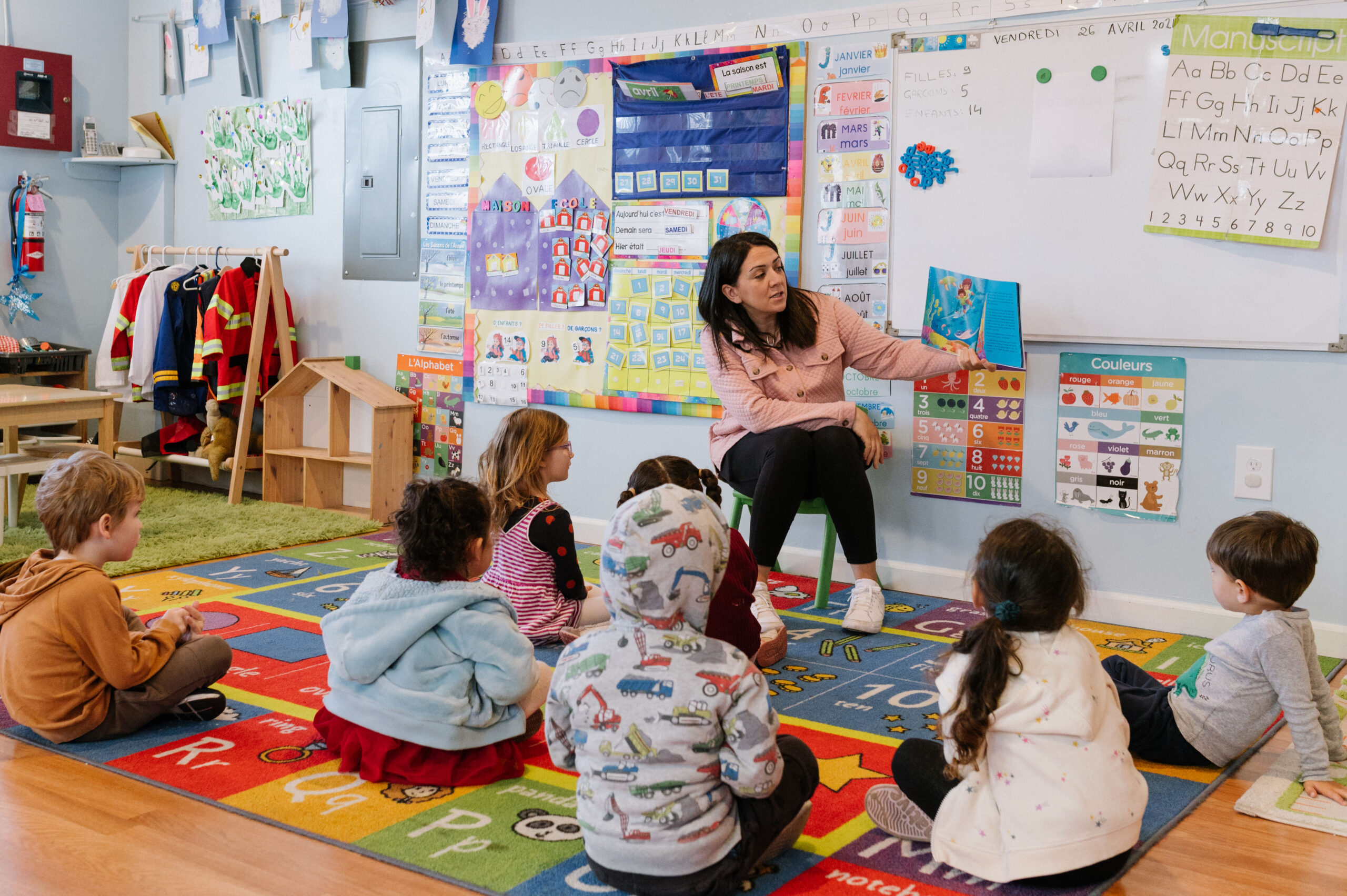
In ABS programs, the setting is language-rich and play-based. Teachers guide children through songs, storytelling, and open-ended art that build early literacy and fine-motor coordination.
For families new to bilingual settings, this is also when language exposure blossoms. In French immersion environments, children start responding to familiar phrases naturally, a sign that comprehension precedes speech, just as it does in their first language.
What Parents Can Do
- Engage in conversation: ask “How did that feel?” or “What happened next?”
- Encourage parallel playdates; side-by-side play builds comfort before true collaboration.
- Keep bedtime and meal routines consistent for emotional regulation.
- Introduce bilingual materials, songs, books, or simple words to support what they hear in school.
Stage 4: Preschoolers – Growing Minds, Growing Confidence (3 – 4 Years)
Preschool: The Foundation of Lifelong Learning
By age three, children have fully entered the preschool stage, a period when they are naturally eager, curious, and developmentally ready for richer learning experiences. At this age, the brain’s language centers are incredibly active, making it an ideal time for immersion programs like ABS’s French curriculum.
Preschoolers:
- Expand vocabulary daily in both native and new languages
- Learn to count, recognize letters, and classify objects
- Develop empathy and perspective-taking
- Strengthen memory, reasoning, and imagination
- Begin goal-oriented tasks like puzzles or small projects
The Role of Preschool Teachers
Educators in high-quality preschools are skilled observers. They design play environments that challenge without overwhelming. At ABS, teachers might introduce a story in French, follow it with a craft, then guide group discussion, integrating art, literacy, and collaboration naturally.
Each moment is intentional: building fine motor skills through art, spatial reasoning through block play, and communication through song.
Supporting Preschoolers at Home
- Ask open questions: “What did you build today?” instead of “Did you have fun?”
- Encourage storytelling. Let your child “read” picture books to you.
- Keep a consistent bedtime; adequate sleep enhances memory consolidation.
- Offer unstructured playtime to balance the structure of school.
Stage 5: Pre-Kindergarten – Readiness and Independence (4 – 5 Years)
Preparing for the Next Step
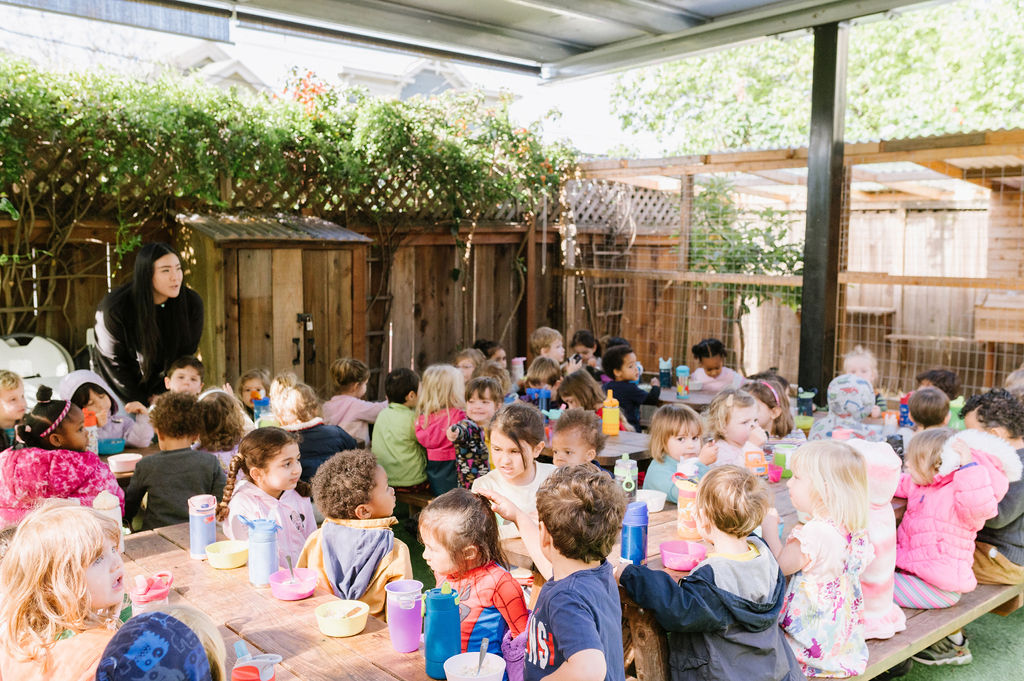
Pre-kindergarten, or Transitional Kindergarten (TK) in California, is the bridge to elementary school. At ABS, the Grande Section fulfills this role, preparing children academically and socially for first grade in either the U.S. or French systems.
Children at this stage:
- Recognize letters, write their names, and begin reading simple words
- Understand quantities, patterns, and number relationships
- Follow multi-step directions
- Work independently for short periods
- Display empathy, cooperation, and emotional control
Classroom Life
In a high-quality child center or preschool, the day becomes more structured: group lessons, small-group projects, outdoor exploration, and creative play balanced with academic focus.
ABS’s pre-kindergarten classrooms follow France’s Éducation nationale framework, which emphasizes five learning domains: language, reasoning, artistic expression, physical movement, and discovery of the world. Lessons flow naturally between them: a song becomes a math pattern, a story inspires writing, a science experiment leads to art.
Family Role in Kindergarten Readiness
- Practice fine-motor skills through coloring, cutting, and building.
- Read aloud daily. Repetition builds confidence.
- Involve children in household routines (setting the table, folding laundry). These tasks promote independence and responsibility.
- Discuss feelings and problem-solving to strengthen social readiness.
Stage 6: Kindergarten – The Launch of Formal Schooling (5 – 6 Years)
The Kindergarten Milestone
Kindergarten marks a major leap, the shift from early childhood care to formal education. In France, children enter elementary school (Cours Préparatoire or CP) at this age; in California, they begin Kindergarten. Despite different systems, the goal is the same: to cultivate curiosity, confidence, and a lifelong love of learning.
Children are expected to:
- Read simple sentences
- Write short stories or journal entries
- Understand number operations and problem-solving
- Collaborate with peers respectfully
- Manage longer school days with fewer rest periods
The ABS Transition
ABS students who complete the Grande Section enter elementary school well prepared, academically bilingual, socially confident, and emotionally resilient. Whether they continue in a French program or a U.S. school, they bring with them the curiosity, independence, and adaptability that began in infancy.
The Power of Continuity in Early Childhood Education
While each age has unique milestones, what matters most is continuity, a seamless path from infant care to kindergarten. Children thrive when they grow within a consistent philosophy of care, communication, and expectations.
At ABS, this continuity is intentional. The same child-centered principles guide every classroom:
- Warm relationships first, because children learn best when they feel safe.
- Hands-on exploration to keep curiosity alive.
- Language immersion to expand brain connections.
- Cultural awareness to build empathy and a global perspective.
- Joyful learning that makes every day meaningful.
Families who stay within one cohesive environment from infancy through kindergarten often see smoother transitions, stronger friendships, and deeper confidence.
Supporting Your Child at Every Stage
Parents are a child’s first and most important teachers. Whether you’re rocking your newborn, chasing your toddler, or helping your preschooler write their name, you’re shaping how they view learning.
Here are a few universal principles that apply from infant care to kindergarten:
- Consistency builds confidence. Keep routines steady; it signals safety.
- Play is learning. Every block tower, dance, or song strengthens the brain.
- Talk often. Conversation fuels vocabulary and emotional intelligence.
- Encourage curiosity. When children ask “why,” respond with wonder, not worry.
- Partner with teachers. Stay connected to your child’s caregivers and educators; together, you build the foundation for lifelong success.
Why Families Choose ABS
For families in the Bay Area seeking a preschool or child care center that grows with their child, Au Beau Séjour French Preschool offers more than early education; it offers a community.
- Infant and Toddler Programs: nurturing care that honors each child’s rhythm.
- Preschool and Pre-Kindergarten: a bilingual curriculum blending French structure with American creativity.
- Small Class Sizes: individualized attention and strong family partnerships.
- Whole-Child Approach: art, music, gardening, yoga, and outdoor play woven into each day.
At ABS, early learning isn’t a checklist of milestones; it’s a journey of discovery. From your baby’s first smile to their first school presentation, we’re here to guide, encourage, and celebrate every step.
The Journey From Cradle to Classroom
Understanding each stage of early learning helps parents appreciate the miracle of growth. Infancy builds trust; toddlerhood sparks curiosity; preschool develops confidence; and kindergarten launches independence.
Each stage is precious, and when nurtured in a caring, stimulating environment, each becomes the stepping stone to the next.
At Au Beau Séjour French Preschool, we honor that journey every day. From infants to kindergarten, we provide a safe, joyful, and enriching environment where children can explore, imagine, and thrive in two languages and with one unshakable foundation: love for learning.